AI & Your Digital Footprint: Track Less, Stay Safer

How AI Shapes and Safeguards Your Digital Footprint
Artificial intelligence influences what gets collected about people online, how it’s interpreted, and how quickly it can spread. The same technology that powers personalization and fraud detection can also intensify tracking, profiling, and impersonation. This guide breaks down where AI touches everyday digital life and how to use AI-assisted habits and tools to reduce risk while keeping convenience.
What a Digital Footprint Looks Like Today
A modern digital footprint is more than what gets posted publicly. AI systems can turn small traces into surprisingly detailed profiles—often through inference rather than direct disclosure.
- Active footprint: posts, comments, reviews, photos, resumes, profiles, and messages shared publicly.
- Passive footprint: device identifiers, location signals, browsing telemetry, ad IDs, cookie-based behavior, and app analytics.
- Inferred footprint: predictions about income range, interests, health topics, political leanings, and purchase intent generated from behavioral patterns.
- Why it matters: inference often drives ads, offers, pricing, credit decisions, moderation, and reputation scoring.
How AI Expands Tracking and Profiling
AI doesn’t just collect; it connects. When systems recognize patterns across platforms, your footprint becomes easier to match, categorize, and monetize.
- Identity resolution: pattern recognition links scattered data points across devices and accounts, strengthening “who is who” matching.
- Lookalike modeling: places people into audiences based on similarity to other users—even when direct data is limited.
- Content analysis: reads text, images, and audio for sentiment, topics, and entities, turning unstructured posts into structured profiles.
- Predictive personalization: can narrow what you see and reinforce assumptions, creating filter bubbles.
Common AI-Driven Footprint Touchpoints
| Touchpoint | What AI Does | What It Can Reveal | Practical Mitigation |
|---|---|---|---|
| Social platforms | Classifies content, ranks feeds, suggests connections | Interests, relationships, routines | Tighten audience settings, review tagged photos, limit public followers |
| Search and browsing | Predicts intent, personalizes results/ads | Health/finance curiosities, purchase plans | Use privacy-focused browsers, clear permissions, separate profiles for sensitive searches |
| Mobile apps | Detects churn, monetizes via targeting | Location patterns, daily schedule | Disable background location, audit app permissions monthly |
| Email and messages | Filters spam/phishing, extracts entities | Contacts graph, workplace/org ties | Enable MFA, reduce public exposure of email, use aliases for sign-ups |
| Photos and video | Recognizes faces/places/objects | Identity, travel history, companions | Remove EXIF where possible, avoid posting real-time location, restrict auto-tagging |
Where AI Helps Protect Your Online Footprint
Not all AI is surveillance. Many protections rely on AI because threats move fast and operate at scale.
- Fraud detection: flags unusual logins, impossible travel, and automated abuse patterns.
- Phishing and scam detection: uses language cues, sender reputation, and behavior patterns to block malicious messages.
- Account security prompts: detects password reuse and credential leaks and nudges resets and multi-factor authentication.
- Endpoint and browser defenses: machine learning helps detect malware families and suspicious behavior earlier.
- Privacy-preserving methods: approaches like differential privacy, on-device processing, and federated learning can reduce raw data exposure when implemented well.
For practical, consumer-focused privacy guidance and controls, the Federal Trade Commission’s privacy tips are a useful baseline. For a security lens on scams, review CISA’s guidance on social engineering and phishing.
New Risks: Deepfakes, Voice Cloning, and Synthetic Identity
AI-powered manipulation raises the stakes because convincing fakes can be created quickly, cheaply, and repeatedly.
- Deepfakes: fabricated video or audio that appears authentic can accelerate reputational harm and complicate “proof” in disputes.
- Voice cloning: convincing phone scams and urgent-request impersonations can be built from short audio samples.
- Synthetic identity fraud: blends real and fake data to bypass checks, potentially leading to account takeover or credit damage.
- Scalable harassment: AI can generate messages, summarize doxxing details, or create manipulated screenshots, increasing volume and pressure.
Risk frameworks such as the NIST AI Risk Management Framework (AI RMF 1.0) highlight that AI risk isn’t just technical—it affects safety, reputation, and real-world outcomes.
A Practical AI-Aware Privacy Checkup (30–60 Minutes)
Small changes can noticeably reduce what AI systems can infer and how easily an attacker can impersonate you.
Smarter Sharing Habits in an AI-Readable World
Using AI to Defend Yourself (Without Handing Over More Data)
A Deeper Walkthrough and Action Plan
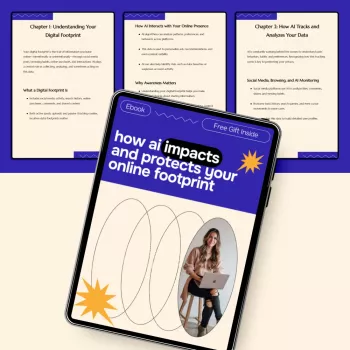
Step-by-step guidance can make audits faster, explain AI-driven threats in plain language, and provide reusable checklists for ongoing maintenance. For a structured approach to understanding AI’s role in tracking, inference, and protection—and for a practical plan to reduce exposure—see How AI Impacts and Protects Your Online Footprint: Ultimate Guide to AI and Your Digital Footprint.
Helpful digital guides to keep momentum
- How AI Impacts and Protects Your Online Footprint: Ultimate Guide to AI and Your Digital Footprint ($18.99)
- Travel Solo With Confidence: A Practical Guide to Overcoming Fear and Anxiety for Solo Travelers ($12.99)
- Empower Your Inner Voice – A Practical eBook Guide on how to overcome self doubt, Build Confidence, and Strengthen Mindset for Personal Growth ($18.99)
FAQ
Can AI figure out personal details even if nothing private is posted?
Yes. AI can infer attributes by combining small signals like browsing patterns, location routines, likes, and social connections. Reduce the available signals by tightening app permissions, limiting ad personalization, and separating identities for different activities (shopping, public posting, and private communication).
What’s the fastest way to reduce risk from account takeover?
Turn on MFA, switch to a password manager with unique passwords for every account, and remove old devices/sessions from your security settings. Add login alerts and check whether your email or passwords have appeared in breach notifications so you can reset quickly.
How can deepfake and impersonation damage be limited?
Limit public-facing audio/video where possible, and lock down who can tag or mention you. If something happens, document evidence immediately, report impersonation through the platform’s official channels, and notify friends or coworkers through a trusted contact method so scams don’t spread.










Leave a comment